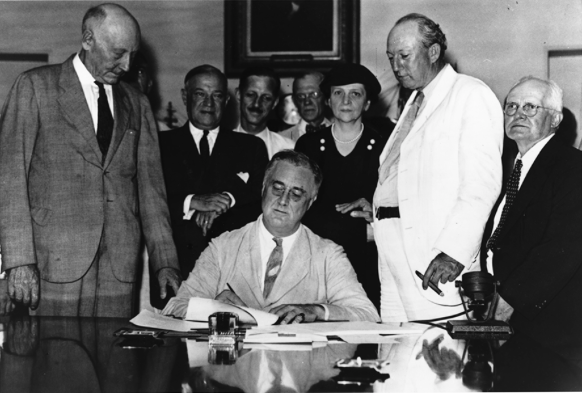
FDR signs Social Security Act 1935
Detroit News May 2,
1937
UAW Packard edition: February 15,
1942 Detroit News May 20,
1943
USA
USA2 USA3
|
The Adventures of Dasein:
From the Origins of Language to the End of Print Literacy in the United States
a critique of marxism

UAW Unity Caucus, 1936-39
Ike and McCarthy: Dwight Eisenhower's Secret Campaign against Joseph McCarthy ●
This site is a rhizome.
This site is a rhizome.
Its principle of production is transcendental empiricism.
It uses figurative elements, including graphs, tables, charts,
and maps, originally to advance an analysis of the historical
trajectory: the New Deal to Donald Trump, but the events of the second
decade of the 21st century, when viewed through the lens provided by
The Social Origins of Language, forced me to see that there was a
bigger picture. This bigger picture is represented by Figure 0.1.
From the Origins of Language to the End of Print Literacy in the United
States. Figure 0.1 is the irreducible minimum if one is to understand the New
Deal, "Trump," and the historical path connecting them. This is because "Trump" forces us to face the question of our primate heritage and its corrolary,
patrimonialism),
on the one hand, and the fragility of print-based civilization, on
the other.
Taking into account
the major perspectives on the development of
language and cognition, and applying these results and methodologies to
the cognitive-discursive performativities of schooling, politics, and
the media, we are led to a chilling conclusion: we are now
living through the disintegration of the cognitive-discursive
performativities associated with the biocultural niche of
modernity. What
is happening now is beyond the cognitive scope of current
popular and much scholarly thought, which is economistic in character and Cartesian in its
metaphysical presuppositions.
Context for understanding what is happening now is provided by Martyn
Lyons. A theoretical framework for understanding what is
happening now is provided by Merlin Donald.
|
|
Bildung and Literacy: On Reading as a Transformative Process
|
Martyn Lyons, A History of Reading and Writing In the Western World (PalgraveMacmillan, 2010)
9. The Reading Fever, 1750-1830
("Everyone in Paris is reading . . . People read while riding in
carriages or taking walks . . . Women, children, journeymen
and apprentices read in shops. On Sundays people read while
seated at the front of their houses; lackeys read on their
back seats, coachmen up on their boxes, and soldiers keeping guard."
10. The Age of the Mass Reading Public (“Between the 1830s and the First World War . . . a mass reading public came into existence.”)
11. New Readers and Reading Cultures ("The half century between the 1880s and the 1930s was the golden age of the book in the West.")
|

|
|
brain plasticity, biocultural niche, intersubjectivity
decades of intensive schooling (vs. Mortimer, Simon, Wellman)
Donald demolishes the intellectual foundations of racism
Donald's horizon is too restricted. Formal education is not the
only path to the "massive restructuring" involving the "complex neural
components of a reading vocabulary or the elaborate
procedural habits of formal thinking" developed over "decades of
intensive schooling." E.P. Thompson and Jacques Rancière--the
question of Bildung and the failure to address it by marxists, who did
not follow up on E.P. and Jacques implicit focus on bildung, is part of this critique of marxism.
This is a major theme that ties the various parts of this site together.
|
|
from from Merlin Donald, A Mind So Rare: the Evolution of Human Consciousness (W.W. Norton, 2001), pp. 301-2
. . . modern
culture contains within it a trace of each of our previous stages of
cognitive evolution. It still rests on the same old primate brain
capacity for episodic or event knowledge. But it has three
additional, uniquely human layers: a mimetic layer, an oral-linguistic
layer, and an external-symbolic layer. The minds of individuals
reflect these three ways of representing reality. 262
Something about our mentality changed in the past few millenia,
something that made us able to construct such exotic things as
symphonies, philosophies, oil refineries, nuclear weapons, and
robots. Do such achievements have implications for theories of
consciousness? Many would deny that they do. They would
claim that the parameters of mind were surely fixed long ago, when we
emerged as a species, and that culture can add nothing to an equation
written deeply into the human genome.
The human mind is so plastic in the way it carries out its cognitive
business, individually and in groups, that the core configuration of
skills that defines a mind actually varies significantly as a function
of different kinds of culture. This is especially true of the
most conscious domains of mind, such as those involved in formal
thinking and representation.
Literacy skills change the functional organization of the brain and
deeply influence how individuals and communities of literate
individuals perform cognitive work. Mass literacy has triggered
two kinds of major cogitive reorganizations, one in individuals and the
other in groups.
To become fully literate, the individual must acquire a host of neural
demons that are completely absent from anyone who lacks literacy
training. This involves massive restructuring. There is no
equivalent in the preliterate mind to the circuits that hold the
complex neural components of a reading vocabulary or the elaborate
procedural habits of formal thinking. These are unnatural.
They have to be hammered in by decades of intensive schooling, which
changes the functional uses of certain brain circuits and rewire the
functional architecture of thought. This process can be very
extensive. Consider the impact of twenty or more years of schooling on
the brain of someone who has acquired full symbolic literacy in several
different technical, mathematical, scientific, and musical
fields. These skills encumber neural resources on a vast scale
and change how the person's mind carries out its work.
|
|
organization and geography matter
The UAW-Unity Caucus, 1933-1943: Intersubjectivity, Shared
Intentionality, and the Extended Mind (Bildungsproletarians and
Plebeian Upstarts),
is a map of sources. The organization of auto workers in
southeastern Michigan was the culmination of the biocultural,
developmental processes that Lyons (A History of Reading and Wrting) provides a framework for thinking about. At issue is the question of agency--the emotional forces and the cognitive-discursive performativities of situated humans.
Also at issue is the question of fascism; the problemmatic of fascism; the riddle of fascism. fascism.
And the question of anti-communism as the name I give to the black hole
at the heart of the public sphere that not only distorts but determines
the permissible boundaries and semiotic content of public discourse.
While I interviewed
veterans of the organizational struggle from the Conner Avenue area on
the far east side of Detroit (Briggs, Budd Wheel, Hudson, and Chrysler), and workers from Fleetwood, Ternstedt,
and Ford on the west side of the city, the most intensive work was done
with veterans of the organizational struggle on the near east side:
Michigan Steel Tube, Chrysler Highland Park, Murray Body, Dodge Main,
Midland Steel, Detroit Steel Products, Packard, and Plymouth, and with
veterans of the organizational struggle in Flint (Fisher 1, Chevrolet, and Buick) and Pontiac (Pontiac Motors, Yellow Cab).
What
made this whole site
possible is the literary and cognitive capabilities of the
bildungs-proletarians and plebeian upstarts whom I interviewed.
These
bildungs-proletarians inhabited the biocultural niche of modernity.
They were intensely rather that merely
literate. In
this regard they had more in common with the the Keynesian Elite in the
New Deal State than they had with the “masses” of their fellow workers
in
the plants. For this reason it was
possible to co-construct a discursive web incorporating all the
interviews that, in another context, could be referred to as the
extended mind of the Unity caucus.
It was these bildungs-proletarians around whom formed the action
networks of plebeian upstarts (the Unity Caucus) who created the modern
UAW in the 1930s. From the standpoint of praxis both the Unity
Caucus and the Keynesian elite should be conceived of as vanguard
formations within the biocultural field of Progressivism.
All of us historians who interviewed these workers back in the nineteen
seventies and eighties were not only struck by their powers of mind,
but also by what can only be described as their strength of
character. They were the embodiment of civic republicanism.
Mind matters. (Hegel)
|
|
The UAW-Unity Caucus, 1933-1943:
Intersubjectivity, Shared Intentionality, and the Extended Mind
Bildungsproletarians and Plebeian Upstarts

the UAW, 1933-1943: a working notebook

↑
↑
Dodge
Main
Midland
Steel
See the evolving UAW-New Deal page here
|
|
the Keynesian Elite in the New Deal State:
Intersubjectivity, Shared Intentionality, and the Extended Mind

Source: "Membership List, May 1927" in the Morris L. Cooke Papers, box 66, FDR Library,
and The United States Government Manual 1937. Also: the Papers of John M. Carmody
The Keynesian Elite in the New Deal State: Career Matrix
Nobuo Noda, How Japan Absorbed American Management Methods (Asian Productivity Organization, 1969)
Ordway Tead, "An Interpretative Forecast of the NRA: Is the Trend Toward Fascist or
Socialized Self-Government?" Bulletin of the Taylor Society, August 1933
For context see Elites: Strategic and Otherwise
FDR vs. the Slave Power: MEMO July 10, 1935
"Liberal Businessmen" Ezekiel
See the evolving KE-NewDeal page here
|
|
Interrogating Dasein:
Bildungs-proletarians and Plebeian Upstarts
|
|
|
|

|
this theme of cog-disc perf continues in the looking at the "New Deal".
Plane of Immanence (Deleuze)
|
|
Figure 1a. The UAW-Unity
Caucus, 1933-1943
|
praxiological ratios
a. plebeian upstarts
1. the Joe Adams ratio: 10.6% (Dodge Main) PF
2. the Charlie Yaeger ratio: 7.2% (Buick) Skeels
3. the Bud Simons ratio: 7.5% (Fisher Body 1) Skeels
4. the Cliff Williams ratio: 7.1% (Pontiac Motors) PF
b. bildungsproletarians: about one in thousand
Dodge Main: 2 ratios (21,894 members in Fall 1939)
n=34. (0.16%): Emergency Meeting of Chrysler Executive Boards and Shop Committees, October 8, 1939
n=13 (0.06%): Meeting of the Chrysler Executive Boards and shop committees, November 7, 1939
|
Bildungsproletarians' encounters with the "world"
1. encounters with "the grey masses"
a. patrimonial formations: gangs and grifters
b. Masons and K of C
c. the middle (hometownsmen): Elder, Wainwright
d. Polish women (Herman Burt)
e. workhorse uncle toms
f. Hillbillies
2. encounters with "the middling sort"
a. Ben Wainwright interview
b. the Elder report
3. encounters with the skilled trades
a. Mazey on the skilled trades in Briggs
b. Fagan on the "Americans": AAIA, KKK, Bl. Legion
c. Kluck on skilled trades: Homer Martin
d. Kord on the colonization of the tool room UNITY
4. encounters with plebeian upstarts
a. Bud Simons on Toledo flying squadron
b. Edmund Kord on guys from front welding
c. Edmund Kord on the youth "gangs" in the press
rooms
d. Bill Mazey and Joe Adams on the Italians
e. Frank Fagan on the welders in his department/body-
in-white
5. encounters with management
a. Earl Reynolds
b. Bud Simons and Frank Fagan
c. Murray Body spring committee
6. encounters with fascism
a. Bud Simons experience in Saginaw
b. Victor Reuther experience in Anderson
c. Cliff Williams vs. Bert Harris
d. Packard
e. Maurice Sugar in the elevator
f. Lindahl on 1938 meeting (letter to Lewis)
Reformation Roots
from Richard White, The Republic for which it Stands: the United States during Reconstruction and the Gilded Age, 1865-1896 (Oxford, 2017), p. 776
Pullman's workers had
not been plucked from the slums; they were unlikely to come from
neighborhoods around Hull House on Halstead Street. His factory
in the 1880s employed about 75 percent skilled workers . . . and most
were northern European immigrants: Swedes, Germans, English and Dutch.
|
Networks of Power

Why Dasein?
Reformation "Roots"

Jóhann Páll Árnsason and Björn Wittrock, eds., Nordic Paths to Modernity (Bergham Books, 2012)
Jennifer A. Herdt, Forming Humanity: Redeeming the German Bildung Tradition (Chicago, 2019).
Esp. re. the role of Pietists in American Civil War (pp. 21,
59-60) England, Netherlands, Germany.
Bruce Laurie, Rebels in Paradise: Sketches of Northampton Abolitionists (U. of Mass. Press, 2015)
Bruce Laurie, Beyond Garrison: Antislavery and Social Reform (Cambridge, 2005)
John Donoghue, Fire Under the Ashes: an Atlantic History of the English Revolution (Chicago, 2013)
Kenyon Gradert, Puritan Spirits in the Abolitionist Imagination (Chicago, 2020)
John L. Brooke, "There is a North": Fugitive Slaves, Political Crisis, and Cultural Transformation in the Coming of the Civil War (University of Massachusetts Press, 2019)
Zachary A. Fry, A Republic in the Ranks: Loyalty and Dissent in the Army of the Republic (U. of N. Carolina Press, 2020)
James Brewer Stewart, Holy Warriors: The Abolitionists and American Slavery (Hill and Wang, 1997)
|
|
|
|