|
Morris L. Cooke,
the central figure of the Taylor Societ,) can stand for a homogeneous
praxiological habitus, milieu, and network: the Keynesian Elite
(see Fig. 2).
FDR, on the other hand, stands for the ontological heterogeneity of his
Administration, as the site of fundamental conflict between competing
elites (Fig. 1), as the scene of emergent functions and institutional
formations (NLRB, NRPB, etc.), and the locus of synthesis of elite
competition into a homogeneous form of hegemony over the population:
the Cold War and anti-Communism(1). The guise in which this
appears today [[2009]] is The War on Terror. It is utterly
naive to conceive of FDR or any modern President as a unitary,
homogeneous agent. (pre-operational ontology: the morally
acountable individual--the Cartesian self--and nothing else.)
|

|
These competing elites are in part defined by the input-ouput matrices (really existing markets, praxiological flows) of the major sectors of the American political economy (Fig. 1). Such matrices are shorthand ways of referring to inputs of money, raw materials, intermediate goods, and services; and outputs of raw materials, intermediate goods, finished goods, and services. For three examples, see below: Figure 5. Taylor Society, 1927: Mass Distribution, input-output flows; Figure 6. Taylor Society, 1927: Mass Housing, input-output flows; and Figure 13. Local companies, designers, and laborers that worked on the Northern Life Tower. Cooke was active in the Brookwood Labor College (see Our labor movement today, by Katherine H. Pollak (Brookwood Labor Pamphlets), Conference for Progressive Political Action, and had an extensive correspondence with A. J. Muste, who played an important role in the Toledo Auto Lite Strike of 1934. Brookwood supplied a large number of its students into the fledgling UAW, including Victor Reuther . . . Cooke's "CIO" address to the TS and Brookwood Labor College Pamphlet |

|
The Securities bloc was the object of analysis by Louis D. Brandeis in his book Other People's Money. Brandeis used the results of the Pujo Committee's Investigation of Financial and Monetary Conditions in the United States (see Pujo Committee Interlocking Directorates 1912). A defining moment in the conflict between the emerging mass consumption sector and the Securities bloc was the Eastern Rate Case of 1910, out of which emerged the Taylor Society. (see unfinished tables here.) Brandeis can be considered the godfather of the Keynesian elite. |

The Keynesian Elite: Habitus, Milieu, Network
The place to really get a feel for the psychological-developmental ethos of Bildung and the Will to Power is in the documents listed below, all of which are available on the Internet: The Eastern Rate Case: Evidence Taken by the Interstate Commerce Commission in the Matter of Proposed Advances in Freight Rates by Carriers, August to December 1910, Senate Doc. 725, 61 Cong., 3 Sess. This can now be read online. Below are some excerpts. Louis D. Brandeis to Robert Marion Lafollette, July 29, 1911 The Bulletin of the Taylor Society The Papers of Morris L. Cooke (FDR Library) LaFollette Committee Hearings. Establishment of National Economic Council. Hearings before a subcommittee of the Committee on Manufactures, United States Senate, Seventy-second Congress, first session, on S. 6215 (71st Congress) a bill to establish a National Economic Council. Printed for the use of the Committee on Manufactures. Brian Van De Mark, "Beard on Lippmann: The Scholar vs. the Critic" The New England Quarterly, Vol. 59, No. 3 (Sep., 1986), pp. 402-405 Irving Brant (editorial editor St. Louis Star-Times), "The Newspaper in Pulbic Affairs," address at Ninth Anual Neewspaper Week, May 8, 1937, Univerrsity of Colorado College of Journalism. FF-FDR selected letters from Roosesvelt and Frankfurter: Their Correspondence, 1928-1945 (Little Brown, 1967) |
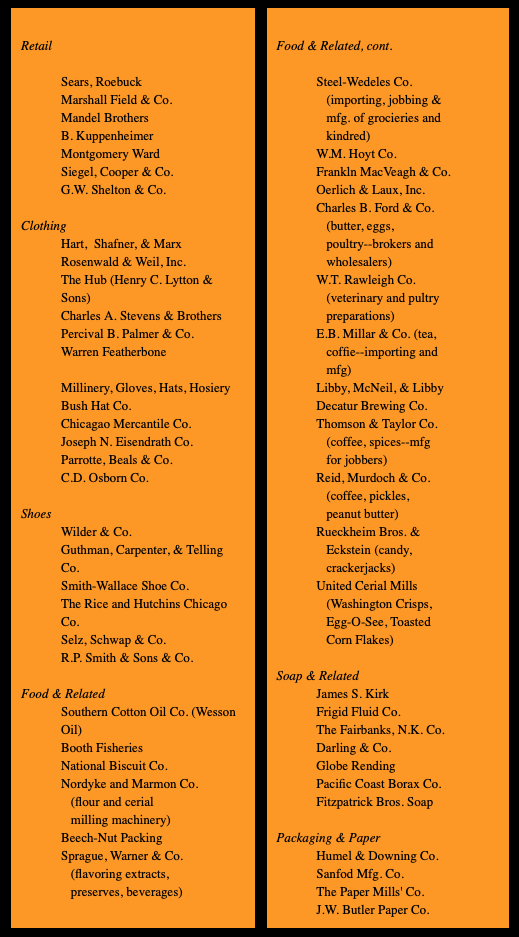
Figure 8a. Eastern Rate Case: Shippers Association, 1910: Chicago subset
Mass Consumer-Oriented Firms
Mass Consumer-Oriented Firms
|
Otis L., Jr. Graham, An Encore for Reform: The Old Progressives and the New Deal (Oxford, 1967)
Alon Gal, Brandeis of Boston (Harvard University Press, 1980) Bruce Allen Murphy, The Brandeis/Frankfurter Connection: The Secret Political Activities of Two Supreme Court Justices (Oxford, 1982) Milton J. Nadworny, Scientific Management and the Unions, 1900‒1932 (Harvard, 1955) Jean Trepp McKelvey, AFL Attitudes toward Production, 1900-1932 (Greenwood Press, 1952) Landon R.Y. Storrs, The Second Red Scare and the Unmaking of the New Deal Left (Princeton University Press, 2012) Roosevelt's Purge : How FDR Fought to Change the Democratic Party |
Mass Housing Supply Firms & Diversified Capital Goods


|
|

|
|
|
|
Figure 7. Taylor Society, 1927: Machinery


